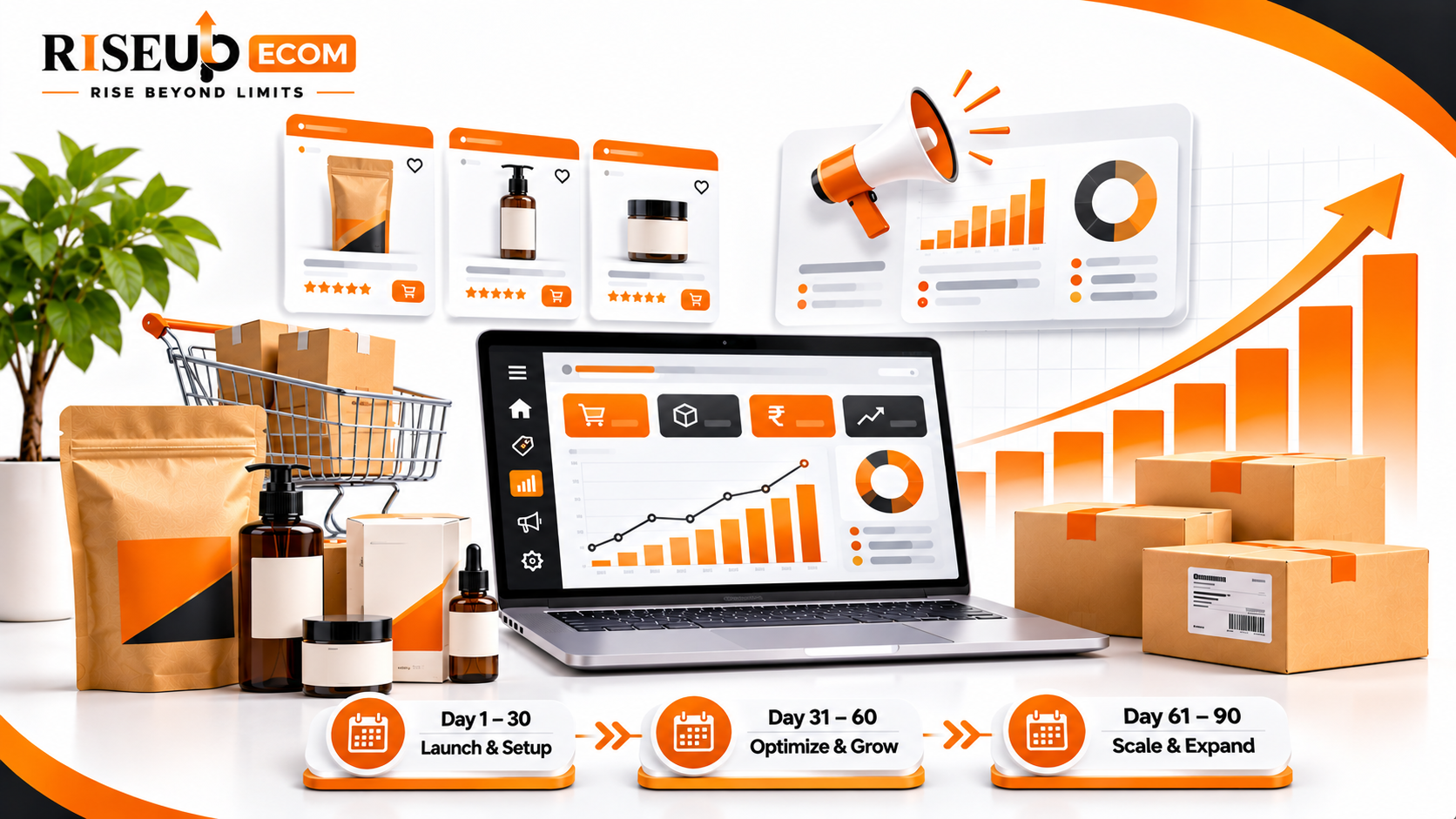
Phase 1: Days 1–30 — Build Your Marketplace Foundation
The first 30 days should be spent preparing your business for launch. The goal is to avoid preventable mistakes after your products become live.
Week 1: Product and Market Research
Before launching your brand, understand what customers are already buying and how competitors are positioning their products.
Start by researching:
- Products with consistent demand
- Competitor pricing and offers
- Customer reviews and ratings
- Common customer complaints
- Product features customers value most
- Product sizes, colors, styles or variations
- Competitor images and listing quality
- Search terms customers use to find similar products
Customer reviews can be particularly useful. They help you identify gaps in existing products, such as poor packaging, incorrect sizing, low durability, missing accessories, or confusing product instructions.
For example, if you are launching a kitchen organizer, customer reviews of competing products may reveal that buyers are concerned about weak materials, inaccurate dimensions, or difficulty assembling the product.
Use these insights to improve your product positioning rather than simply copying competitor listings.
Week 2: Calculate Product Pricing and Profitability
A new brand should understand its actual profit per order before launching.
Your selling price must account for more than product manufacturing or sourcing cost.
Consider the following expenses:
- Product cost
- Packaging cost
- Marketplace commission or referral fees
- Shipping and fulfilment charges
- GST implications
- Advertising expenses
- Return and replacement costs
- Discounts and promotional offers
- Other applicable marketplace charges
Example: Marketplace Product Profit Calculation
Suppose you are launching a product with a selling price of ₹799.
ExpenseAmountSelling price₹799Product cost₹250Packaging₹30Marketplace and fulfilment charges (estimated)₹140Advertising cost per order (estimated)₹100Other costs and return allowance (estimated)₹40Estimated contribution remaining₹239
In this example, ₹239 remains before considering any additional overheads, applicable tax treatment, or other business expenses.
These numbers are illustrative only. Actual marketplace fees, GST treatment, advertising costs, returns, and profitability will vary depending on the category, platform, and seller.
Why this step matters: If your product is already unprofitable at the expected selling price, advertising may increase your order volume without improving your business profitability.
Week 3: Complete Seller Registration and Brand Documentation
Once your product and pricing are finalized, begin marketplace onboarding.
Depending on the marketplace and product category, you may need:
- PAN details
- GST registration, where applicable
- Bank account details
- Business address information
- Brand authorization documents, where applicable
- Trademark documents, where applicable
- Category-specific licences
- Product certification or compliance documents
- Manufacturer or importer details
If you are selling food, electronics, cosmetics, toys, or other regulated products, verify the applicable product compliance requirements before listing.
Complete the onboarding process early because account verification, category approval, brand approval, or documentation issues can delay your launch.
You can also review marketplace onboarding services if you need support setting up seller accounts and preparing for marketplace entry.
Week 4: Prepare Your Product Catalog
Your product catalog is one of the most important parts of your launch.
Customers cannot physically inspect your product online. Your listing must communicate its quality, functionality, benefits, specifications, and value clearly.
Prepare the following for every SKU:
- Product title
- Product description
- Key features and bullet points
- Relevant search keywords
- Product specifications
- Size, color or variation information
- High-quality product images
- Packaging information
- Product dimensions and weight
- Category-specific attributes
- Backend search terms, where supported
A complete catalog reduces avoidable listing errors and gives customers the information they need to make a purchase decision.
Phase 2: Days 31–60 — Launch and Generate Initial Sales
Once your seller account, catalog, inventory, and pricing are ready, you can move into the launch phase.
The objective during this period is not simply to generate as many orders as possible. It is to understand how customers respond to your product and identify what is stopping them from buying.
Week 5: Optimize Product Listings Before Going Live
Before publishing your products, review every listing carefully.
1. Write SEO-Friendly Product Titles
Include relevant search terms while keeping titles clear and readable.
Avoid stuffing unrelated keywords into product titles. Your title should help customers understand what the product is and why it is relevant to their search.
2. Create High-Quality Product Images
Your product images should show:
- The product clearly
- Different angles
- Important features
- Product dimensions
- Material or construction details
- Product usage
- What is included in the package
Use platform-compliant main images and supporting images that answer common customer questions.
3. Write Benefit-Focused Product Descriptions
Instead of only listing technical specifications, explain how the product helps the customer.
For example, instead of writing:
"Made from plastic. Three compartments. Lightweight."
You could explain:
"Organize everyday kitchen essentials in three separate compartments, making frequently used items easier to access while keeping your countertop clutter-free."
The description should remain accurate and should not make unsupported claims.
4. Complete All Relevant Attributes
Attributes such as brand, material, color, size, dimensions, model, compatibility, and product type can help marketplace systems understand your product and improve filtering and discovery.
Missing attributes can also lead to listing quality issues or prevent customers from finding products through category filters.
After your listings are live, check whether everything is working correctly.
Your launch checklist should include:
- Product listings are active.
- Products are searchable.
- Correct category and attributes are selected.
- Product images are displaying correctly.
- Pricing is accurate.
- Inventory is available.
- Shipping and fulfilment settings are correct.
- Variations are linked properly.
- Product descriptions are visible.
- No listing errors or restrictions are present.
Do not assume that a product being marked active means the listing is fully optimized or receiving meaningful search visibility.
Monitor impressions, clicks, sessions, orders, and conversion rate wherever these metrics are available.
Week 7: Start Marketplace Advertising
Advertising can help new brands gain visibility while their products have limited organic sales history.
However, ads should be launched with a clear objective, budget, and monitoring process.
Start by identifying:
- Relevant keywords
- Product targeting opportunities
- Competitor products
- High-intent search terms
- Advertising budget
- Target cost per order
- Acceptable advertising cost
- Products suitable for promotion
For a new brand, it is generally better to start with a manageable campaign structure than to spread your budget across too many campaigns, products, and keywords.
What Should New Brands Advertise First?
Prioritize products that have:
- Competitive pricing
- Strong product images
- Complete and optimized listings
- Good profit margins
- Reliable inventory
- Clear customer demand
- A compelling product differentiator
Avoid promoting every SKU equally. Your best products should receive the majority of your initial attention and testing budget.
For example, if your brand has 20 products, you may initially focus on 3–5 products with the strongest demand potential instead of advertising all 20 at the same time.
Week 8: Analyze Customer Response and Improve
At this point, your marketplace launch should start generating useful performance data.
Look at the following:
MetricWhat It Tells YouWhat to CheckImpressionsHow often products are displayedSearch visibility, keywords, category relevanceClicksWhether shoppers visit your listingImages, price, title, product appealCTRPercentage of impressions generating clicksMain image, title, offer, relevanceConversion ratePercentage of visitors who orderPrice, reviews, description, trust, product valueAd spendAmount spent on advertisingBudget control and campaign efficiencyACOSAdvertising spend compared with attributed salesCampaign profitability and sales efficiencyReturnsOrders returned by customersProduct quality, expectations, sizing, packagingInventoryAvailable stockSales velocity and replenishment planning
Do not make major changes based on one or two days of data. Look for patterns and make controlled improvements.
Phase 3: Days 61–90 — Optimize and Scale Your Brand
The third phase is where you begin making more informed decisions.
You now have some data on customer demand, listing performance, advertising, and operational issues. Use that information to improve the products and campaigns that show potential.
Week 9: Improve Product Visibility and Marketplace SEO
Review your product listings and identify opportunities to improve search visibility.
Focus on:
- Updating titles with relevant search terms
- Improving product descriptions
- Adding missing attributes
- Improving keyword relevance
- Updating images where necessary
- Improving product variation structure
- Reviewing competitor listings
- Checking products with low impressions
If a product is receiving very few impressions, investigate its keyword relevance, category selection, attributes, listing status, and demand before increasing your advertising budget.
Week 10: Optimize Advertising and Reduce Wasted Spend
Review your advertising campaigns to understand which keywords, targeting groups, and products are generating results.
Look for:
- Keywords generating clicks but no orders
- Products with high advertising costs
- Campaigns with low conversion rates
- Search terms generating profitable orders
- Products with strong organic sales
- Advertising spend exceeding your planned limits
Actions you may take include:
- Reducing bids on inefficient targets
- Pausing irrelevant keywords
- Adding negative keywords where supported
- Increasing budgets for campaigns with consistent performance
- Separating high-performing products into dedicated campaigns
- Testing new keywords and targeting opportunities
Do not judge campaign performance only by sales revenue. A campaign can generate revenue while still losing money after product costs and marketplace charges.
Common Mistakes New Brands Make During Marketplace Launches
1. Launching Too Many Products at Once
Uploading a large catalog without prioritizing products can make inventory, advertising, and optimization difficult.
Solution: Start with a focused selection of products and expand based on performance.
2. Spending on Ads Before Optimizing Listings
Advertising brings visitors, but a weak listing may fail to convert them.
Solution: Optimize product titles, images, descriptions, pricing, and attributes before investing heavily in traffic.
3. Ignoring Product Profitability
A product can generate orders but still lose money after marketplace fees, advertising, returns, and fulfilment expenses.
Solution: Calculate your contribution margin and set clear advertising limits.
4. Using Poor Product Images
Low-quality images can make even a good product appear less attractive or less trustworthy.
Solution: Invest in professional product photography and marketplace-compliant images that communicate value.
New listings generally lack the sales history and customer feedback that established products may have.
Solution: Build visibility gradually through listing optimization, relevant advertising, competitive offers, and customer experience improvements.