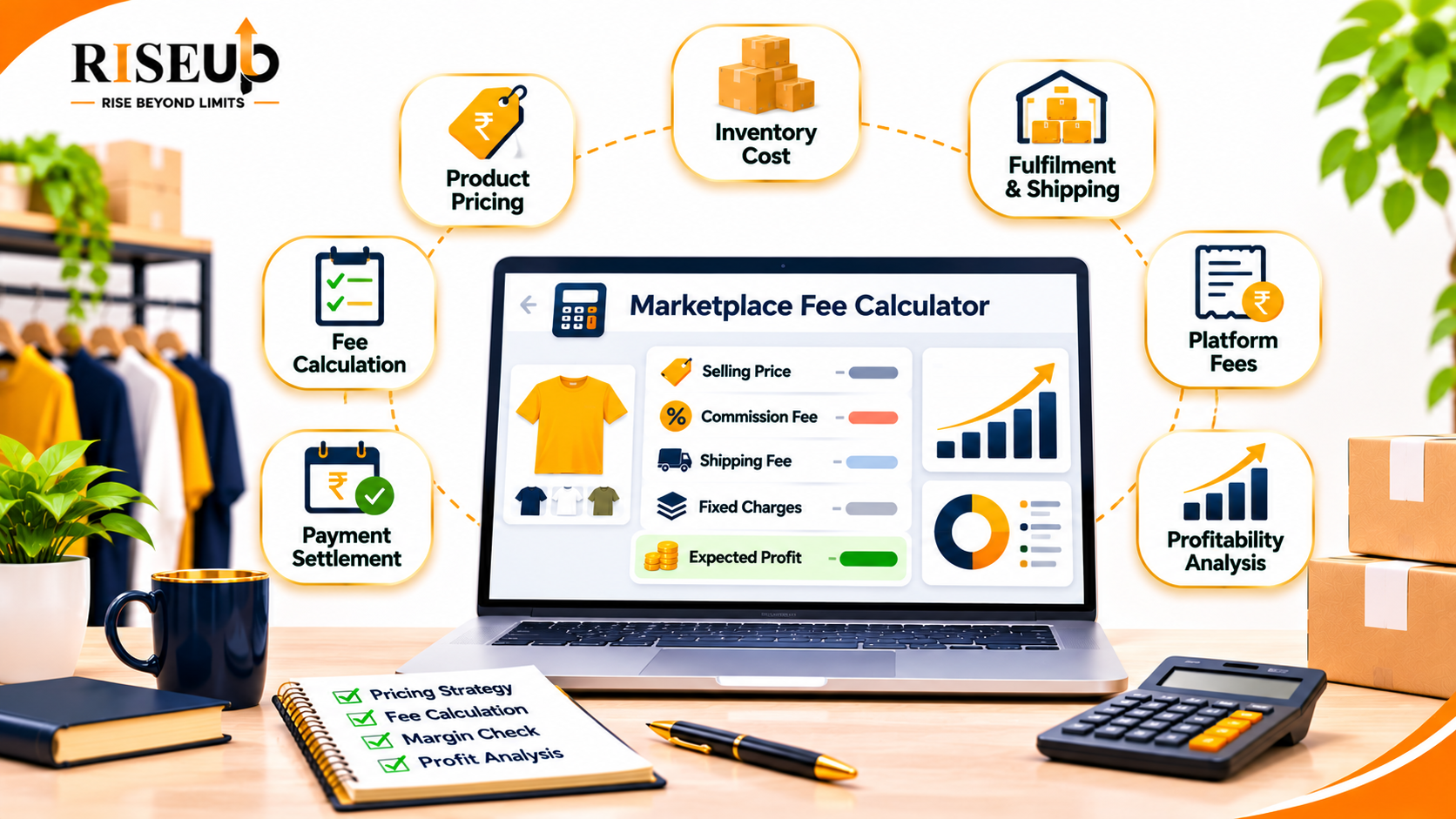
Types of Flipkart Seller Fees Explained
Understanding each fee is more useful than looking only at the commission percentage.
A seller may have zero commission on a particular product but still receive deductions from the final settlement.
Let's understand the main fee components.
1. Flipkart Commission Fee
Commission is a percentage-based marketplace charge associated with the sale of a product.
The applicable rate depends on the product's category and the commission policy for that listing.
For example, a seller offering a non-fashion product priced above ₹1,000 may have to pay a category-specific commission.
However, an eligible product priced below ₹1,000 or a qualifying fashion product at any price may attract zero commission under the announced policies.
How to calculate commission:
Commission = Applicable commission rate × Relevant selling value
For example, if the applicable commission rate is 5% and the relevant selling value is ₹2,000:
Commission = 5% × ₹2,000 = ₹100
This is an illustration of the calculation, not a universal Flipkart commission rate.
2. Flipkart Fixed Fee
A fixed fee is a marketplace charge that is separate from the percentage-based commission.
It is important because sellers may still pay a fixed fee even when the applicable commission is zero.
Flipkart's public fee page describes fixed-fee amounts by average selling-price bands and fulfilment type.
The following figures appear on its published standard rate card:
Average Selling PriceFulfilment by Flipkart (FBF)Non-Fulfilment by Flipkart (NFBF)₹0–₹300₹14₹16₹301–₹500₹14₹16₹501–₹1,000₹30₹30Above ₹1,000₹50₹55
These are published standard-rate-card figures, not a guarantee of the charge on every seller account or order. Flipkart states that rates are subject to change and recommends checking the seller account for the applicable fee.
3. Flipkart Collection Fee
The collection fee is associated with collecting customer payments.
It may depend on the payment method selected by the customer, such as:
- Cash on Delivery (COD).
- Prepaid payment methods such as UPI or net banking.
Flipkart's public fee page displays the following standard collection-fee information:
Average Selling PriceCODPrepaid₹0–₹750₹12.50₹12.50Above ₹7502%2%
These are published standard figures and may not represent the current rate applicable to every account or transaction. Check your own rate card and settlement report for the actual collection fee.
4. Flipkart Shipping Fee
Shipping charges are an important part of marketplace profitability, particularly for sellers dealing with heavy or bulky products.
Flipkart calculates shipping charges based on factors such as:
- Actual shipment weight.
- Volumetric weight.
- Delivery distance or shipping zone.
- Applicable fulfilment arrangement.
- Relevant weight slab.
The chargeable weight can be based on the higher of actual weight and volumetric weight.
Volumetric weight formula:
Volumetric Weight (kg) = (Length × Breadth × Height in cm) ÷ 5000
For example, suppose a packed product measures:
- Length: 30 cm
- Breadth: 20 cm
- Height: 15 cm
Volumetric weight:
(30 × 20 × 15) ÷ 5000 = 1.8 kg
If the actual weight is 1.2 kg, the volumetric weight is higher. The applicable chargeable weight may therefore be based on 1.8 kg, subject to Flipkart's shipping rules and weight slabs.
What Are Local, Zonal and National Shipping Charges?
Shipping charges can differ depending on the delivery location.
Shipping TypeMeaningLocalShipment delivered within the same city or local service area.ZonalShipment delivered within the applicable geographical zone.NationalShipment delivered across different zones.
For example, a seller shipping a parcel within Delhi may have a different shipping charge from a seller shipping the same parcel from Delhi to Bengaluru.
The exact shipping amount should be checked using the applicable weight and location details in your seller account.
Returns can affect seller profitability even when the original sale had a low marketplace fee.
When a customer returns a product, the seller may face additional costs depending on the return type and applicable marketplace policy.
Potential return-related costs include:
- Reverse shipping charges.
- Applicable taxes on service fees.
- Adjustments to the original sale.
- Product damage or inventory loss, where applicable.
For example, a seller selling a ₹499 product with zero commission may still face a financial impact if the customer returns the product and a reverse shipping charge applies.
This is why sellers should consider return rates and reverse logistics while calculating product profitability.
Does Zero Commission Mean Selling on Flipkart Is Free?
No. Zero commission does not mean that selling on Flipkart is completely free.
The zero-commission policy removes the applicable commission charge for qualifying products. Other charges may continue to apply depending on the transaction.
For example, a seller selling an eligible fashion product for ₹1,499 may not pay commission, but the transaction can still involve:
- Fixed fee.
- Shipping fee.
- Collection fee, where applicable.
- Applicable taxes on marketplace services.
- Return-related charges, if the order is returned.
This distinction is especially important for sellers with low-priced products.
A seller who calculates profit using only the commission percentage may underestimate the actual cost of fulfilling an order.
Flipkart FBF vs NFBF: Does Fulfilment Type Affect Seller Fees?
Flipkart offers different fulfilment arrangements, and the applicable charges can vary depending on the selected option.
Two important fulfilment terms are FBF and NFBF.
Fulfilment by Flipkart (FBF)
Under Fulfilment by Flipkart, the marketplace handles specified fulfilment activities such as packaging, shipping and delivery.
The seller follows the applicable process for sending and maintaining inventory for fulfilment.
Non-Fulfilment by Flipkart (NFBF)
Under Non-Fulfilment by Flipkart, the seller handles the relevant packaging and shipping activities according to the marketplace's requirements.
FBF vs NFBF Comparison
FactorFBFNFBFPackagingHandled through Flipkart's fulfilment processSeller handles packagingShippingManaged through Flipkart's fulfilment processSeller follows the applicable shipping processInventory handlingInventory is managed through the fulfilment arrangementSeller manages inventory for fulfilmentApplicable feesFBF-specific rate cardNFBF-specific rate cardOperational responsibilityShared according to fulfilment termsGreater seller involvement in fulfilment
The right option depends on product type, inventory, order volume, operating capacity and the applicable fee structure.
Do not select a fulfilment method only because one fee appears lower. Compare the overall cost and operational requirements.
How to Check Flipkart Seller Commission and Rate Card
The most reliable way to understand your actual Flipkart charges is to check the rate card associated with your seller account.
Third-party websites may display category-wise commission estimates, but those figures can become outdated or may not match the exact sub-category and seller terms.
Follow these general steps:
- Log in to your official Flipkart Seller Hub account.
- Open the Listings or relevant product management section.
- Find the product for which you want to check fees.
- Open the available fee or rate-card information for that listing.
- Review the applicable commission, fixed fee and other charges.
- Check the relevant settlement information after orders are processed.
The exact menu names may change as Flipkart updates its interface.
Official fee information: https://seller.flipkart.com/fees-and-commission
Always compare the public fee information with the rate card available inside your own account.
How to Calculate Flipkart Seller Profit After Fees
Understanding the fee structure is only the first step. Sellers also need to calculate how much money remains after marketplace charges and product costs.
A simple profitability calculation should consider:
- Selling price.
- Product purchase or manufacturing cost.
- Marketplace commission.
- Fixed fee.
- Collection fee.
- Shipping fee.
- Applicable taxes on marketplace services.
- Packaging expenses.
- Advertising costs.
- Return-related expenses.
Flipkart Profit Calculation Example
Suppose you sell a non-fashion product on Flipkart for ₹2,000.
For illustration, assume the following charges:
ParticularsAmountSelling price₹2,000Commission (illustrative 5%)₹100Fixed fee (illustrative NFBF amount)₹55Collection fee (illustrative 2%)₹40Shipping fee (illustrative)₹144Total marketplace fees₹339
The simplified amount remaining after these four marketplace fees is:
₹2,000 − ₹339 = ₹1,661
However, ₹1,661 is not the seller's final business profit.
You still need to account for product cost, packaging, applicable taxes, advertising, returns and other business expenses.
If the product costs ₹900 to manufacture or purchase and packaging costs ₹30, the amount remaining before the other expenses is:
₹1,661 − ₹900 − ₹30 = ₹731
This is an illustrative calculation based on the example published on Flipkart's fee page. It is not a guaranteed payout or profit estimate for your account.
What If Your Product Has Zero Commission?
Suppose an eligible product is priced at ₹799 and qualifies for zero commission.
The seller may still need to account for:
- Fixed fee.
- Shipping fee.
- Collection fee, where applicable.
- Applicable taxes.
- Product cost.
- Packaging and return expenses.
The commission saving improves the calculation, but it does not automatically make the product profitable.
Common Mistakes Sellers Make While Calculating Flipkart Fees
Many sellers focus on the selling price and commission percentage but overlook other costs.
Here are some common mistakes to avoid.
1. Assuming Zero Commission Means Zero Fees
This is one of the most common misunderstandings.
Even when commission is zero, other applicable marketplace charges may still reduce the settlement amount.
Solution: Check the full rate card instead of looking only at the commission percentage.
2. Using an Outdated Commission Chart
Marketplace fee policies can change. Older online charts may show commission rates that no longer apply to qualifying products.
Solution: Verify the latest policy announcements and your own Seller Hub rate card before setting product prices.
3. Ignoring Shipping Weight
Incorrect product dimensions or packed weight can affect the applicable shipping charge.
Solution: Measure the final packed product accurately and review the chargeable weight shown in the seller account.
4. Not Considering Returns
A product may appear profitable on a delivered order but become less profitable after customer returns and reverse logistics costs.
Solution: Review return data and include a reasonable return-cost allowance in your product pricing.
5. Confusing Settlement With Profit
The amount credited to your bank account is not necessarily your actual business profit.
Solution: Maintain a product-level profit sheet that includes product cost, fees, taxes, packaging, advertising and returns.
When sellers participate in discounts or promotional campaigns, their own share of the discount may affect the final amount earned.
Solution: Review the applicable offer contribution and settlement details before joining a campaign.
Frequently Asked Questions About Flipkart Seller Fees & Commission 2026
1. How much commission does Flipkart charge sellers in 2026?
Flipkart's commission depends on the product category and applicable policy. Eligible products below ₹1,000 and all qualifying fashion products at any price have zero commission under the announced policies. Other products may have category-specific commission rates.
2. Is Flipkart commission zero below ₹1,000?
Flipkart announced a zero-commission model for eligible products priced below ₹1,000 on 14 November 2025. Other applicable marketplace fees may still apply.
3. Is Flipkart commission zero on all fashion products?
Yes. On 8 July 2026, Flipkart announced that zero commission would apply across all fashion categories and price points. Sellers should verify that their products are classified under qualifying fashion categories.
4. Does Flipkart charge a fixed fee even when commission is zero?
A zero-commission sale may still attract a fixed fee and other applicable charges. Check your current seller rate card to identify the exact amount.
5. What is the Flipkart collection fee?
The collection fee is a marketplace charge associated with collecting customer payments. Its applicable amount can depend on the order value and the current rate card.